Twin Opaline Globe Floor Lamp with Gold Arc
Dispatch. We dispatch your parcels Monday to Friday, within 1 to 2 working days of order confirmation. Delivery then takes 6 to 18 working days depending on the product and your location.
You will receive tracking information within 24 hours of your order leaving the warehouse, at the email address given at checkout.
Returns and exchanges. Both are accepted within the statutory period of 14 days after your order is delivered to your home.
The stem does not rise straight up: it forms a long arc, an elongated loop that leaves the base and rises to carry the two spheres.
This way of drawing the structure as a continuous line comes from 1960s Italian design, when slim metal replaced massive columns.
The gold finish catches the light of the globes and traces two bright lines from bottom to top.
At 165 centimetres high, the floor lamp fits behind a sofa, in a corner or beside a reading armchair.
The two spheres are set at different heights, one at the top of the arc, the other halfway along.
The light is therefore spread over two levels, lighting a wider area than a single-source floor lamp.
Opal acrylic diffuses with no hotspot and stays milky white even when switched off, which keeps the lamp's graphic look in daylight.
A warm light is enough to turn a corner of the living room into a reading area, without switching on the ceiling light.
A beautiful shape is not enough: the material still has to accept it. Before approving a design, we go through it with the workshops that will make it. Here is how one of our pieces came to life.

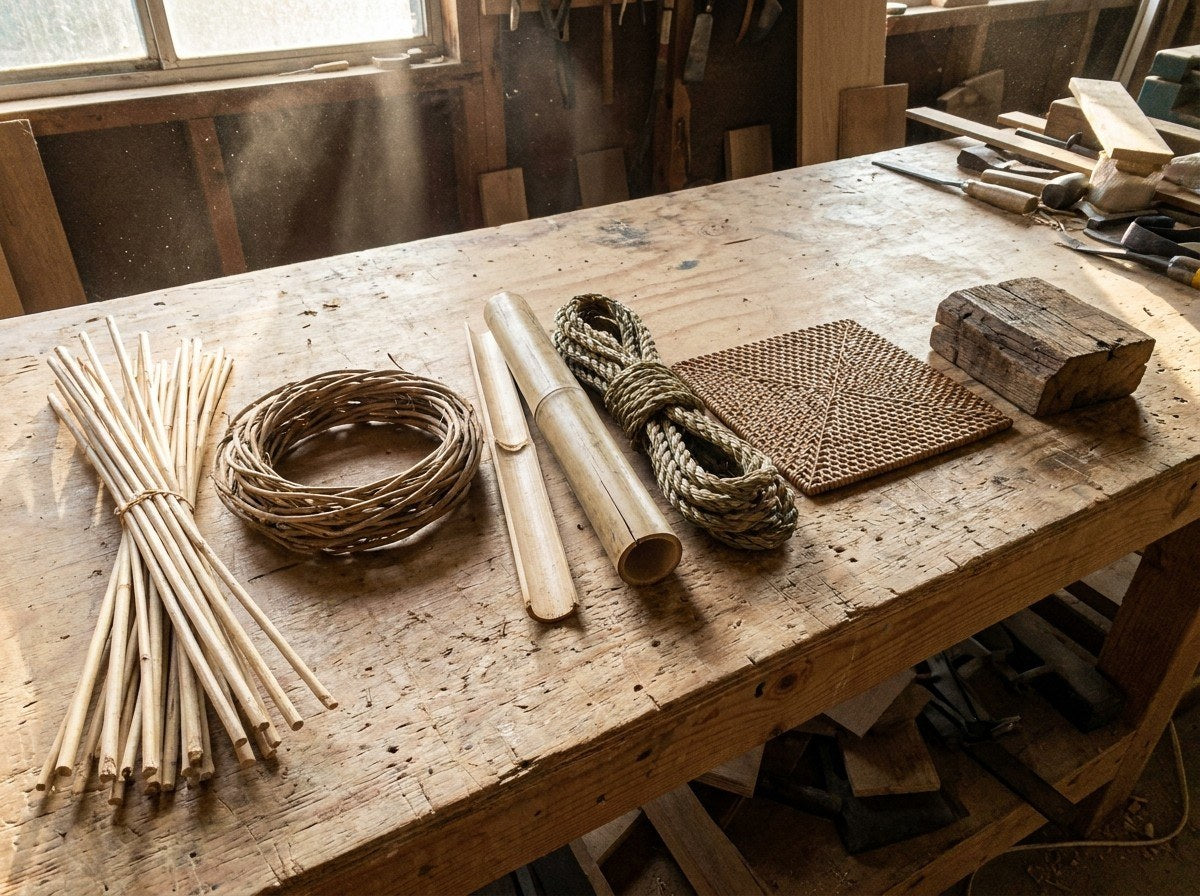
It all starts with a trend. We follow what circulates on Pinterest, Instagram and interior blogs, and we spot the styles on the rise. Here it was the natural look: plant fibres, wide shapes, warm tones. We also look at where the piece will live, and this one needs height or width: above a large table, in a stairwell, under a cathedral ceiling.

The style appelle la fibre végétale, mais toutes ne se valent pas. L'osier casse au cintrage, le jonc de mer reste raide. Le rotin, lui, est une liane de palmier grimpant d'Asie du Sud-Est : trempée, elle devient souple et accepte n'importe quelle courbe, puis se fige en séchant. Sur une pièce de cette envergure, ce rapport entre souplesse au montage et tenue une fois sec décide de tout.

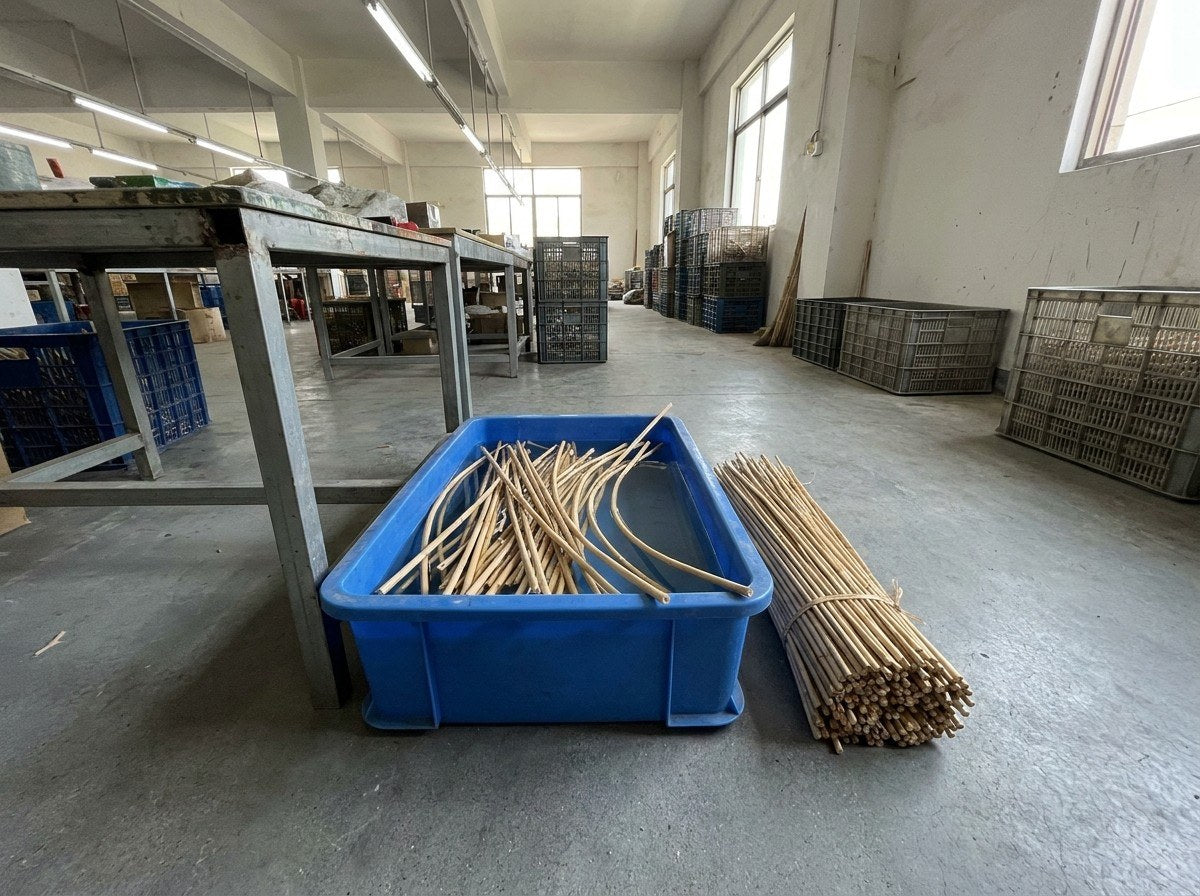
This is where many fine ideas stop. Before going further, we ask the workshop what the material really allows: at that span, will rattan hold? The answer comes down to one simple step, soaking. The strands go into water until they turn supple, they can then be bent without breaking, and they set as they dry. Once feasibility is confirmed, we move on to the drawing.

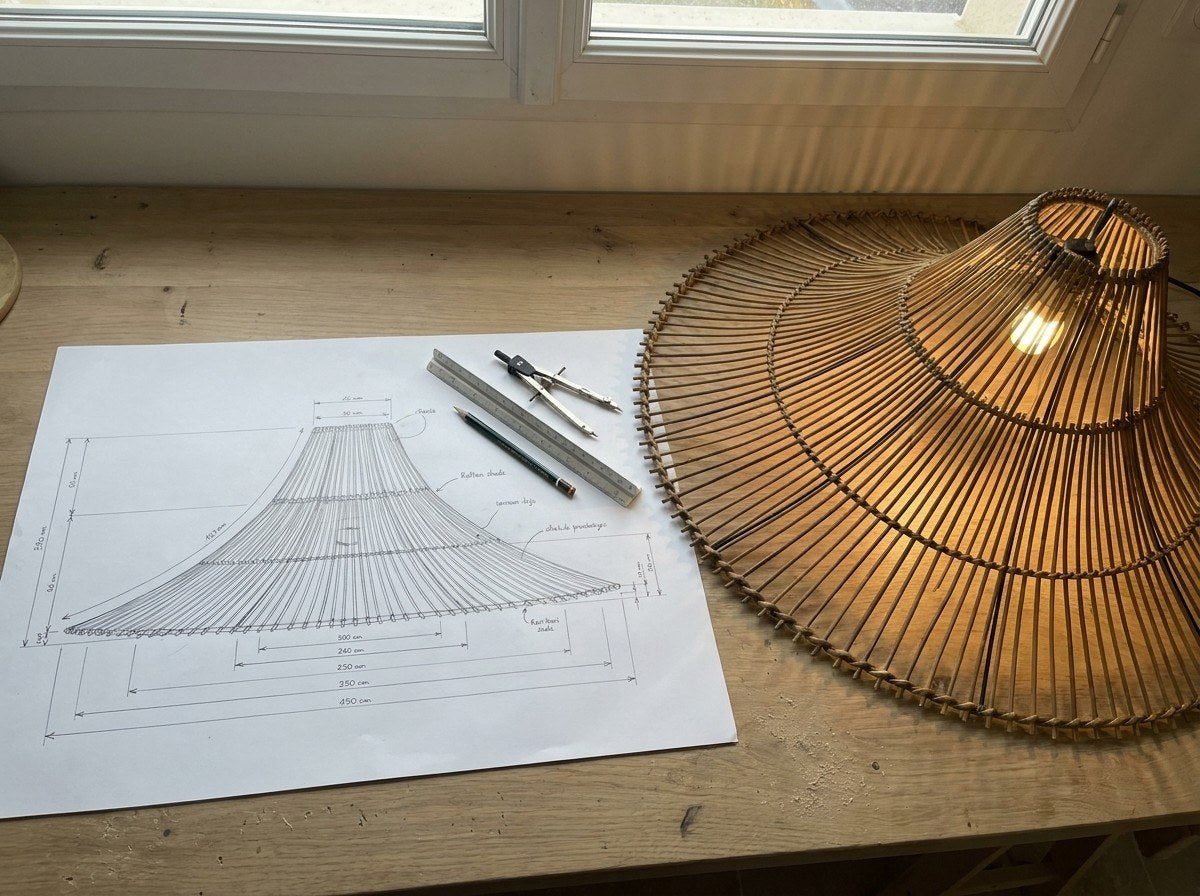
A flared, very open shape, almost a hat, with rods spaced far enough apart for the light to pass between them. The proportions are drawn and redrawn: too flat and the shade dazzles, too deep and it traps the light. A real piece is then assembled and switched on, and we look at the radiating pattern it casts on the ceiling.
Once the design is approved, the workshop starts the production run. The pieces reach the warehouse, where order pickers wrap them one by one before dispatch, ready to dress a new home.