Turkish Mosaic Globe Table Lamp
Dispatch. We dispatch your parcels Monday to Friday, within 1 to 2 working days of order confirmation. Delivery then takes 6 to 18 working days depending on the product and your location.
You will receive tracking information within 24 hours of your order leaving the warehouse, at the email address given at checkout.
Returns and exchanges. Both are accepted within the statutory period of 14 days after your order is delivered to your home.
The globe is made up of hundreds of pieces of coloured glass, laid one by one on a glass shell then sealed with a dark grout that outlines each tessera.
This technique comes from the mosaic workshops of Istanbul, heirs to Ottoman decoration, where the pattern is built as a star from the centre outwards.
The colours are not painted: they are real through-coloured glass, amber, red, cobalt blue, green, which keep their intensity over time.
The patinated metal base, turned and fluted, echoes the shape of traditional oil lamps.
Each lamp shows slight variations in pattern, a direct result of piece-by-piece assembly.
This is the whole point of mosaic: the light does not just come out of the lamp, it passes through each piece of glass and projects its pattern all around.
On a light wall, the room is covered with star-shaped spots of colour, whose density changes with distance.
Lit on its own late in the evening, the lamp is enough to transform the atmosphere of a living room or bedroom.
Switched off, it remains a rich, colourful decorative object to place on a console, a sideboard or a bedside table.
The LED bulb is included and uses little energy, even when left on for several hours.
A beautiful shape is not enough: the material still has to accept it. Before approving a design, we go through it with the workshops that will make it. Here is how one of our pieces came to life.

It all starts with a trend. We follow what circulates on Pinterest, Instagram and interior blogs, and we spot the styles on the rise. Here it was the natural look: plant fibres, wide shapes, warm tones. We also look at where the piece will live, and this one needs height or width: above a large table, in a stairwell, under a cathedral ceiling.

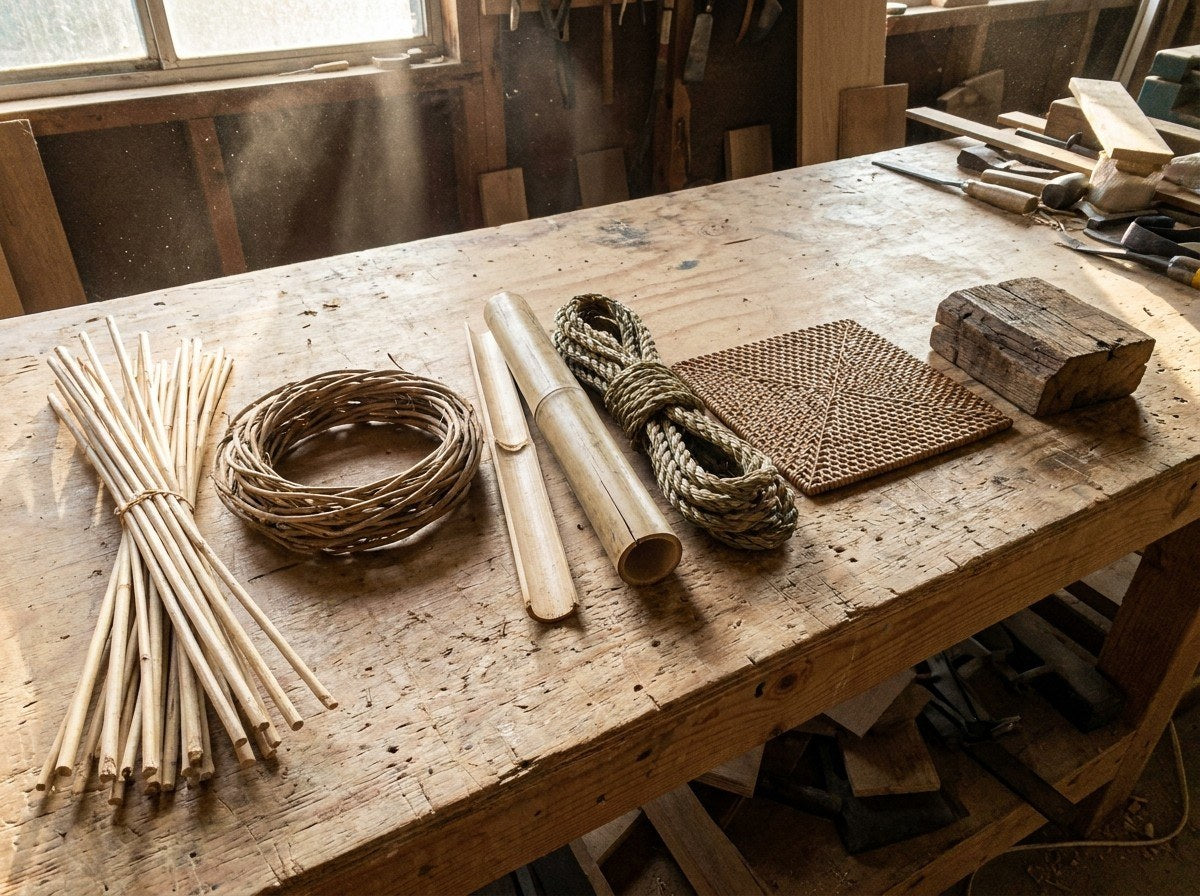
The style appelle la fibre végétale, mais toutes ne se valent pas. L'osier casse au cintrage, le jonc de mer reste raide. Le rotin, lui, est une liane de palmier grimpant d'Asie du Sud-Est : trempée, elle devient souple et accepte n'importe quelle courbe, puis se fige en séchant. Sur une pièce de cette envergure, ce rapport entre souplesse au montage et tenue une fois sec décide de tout.

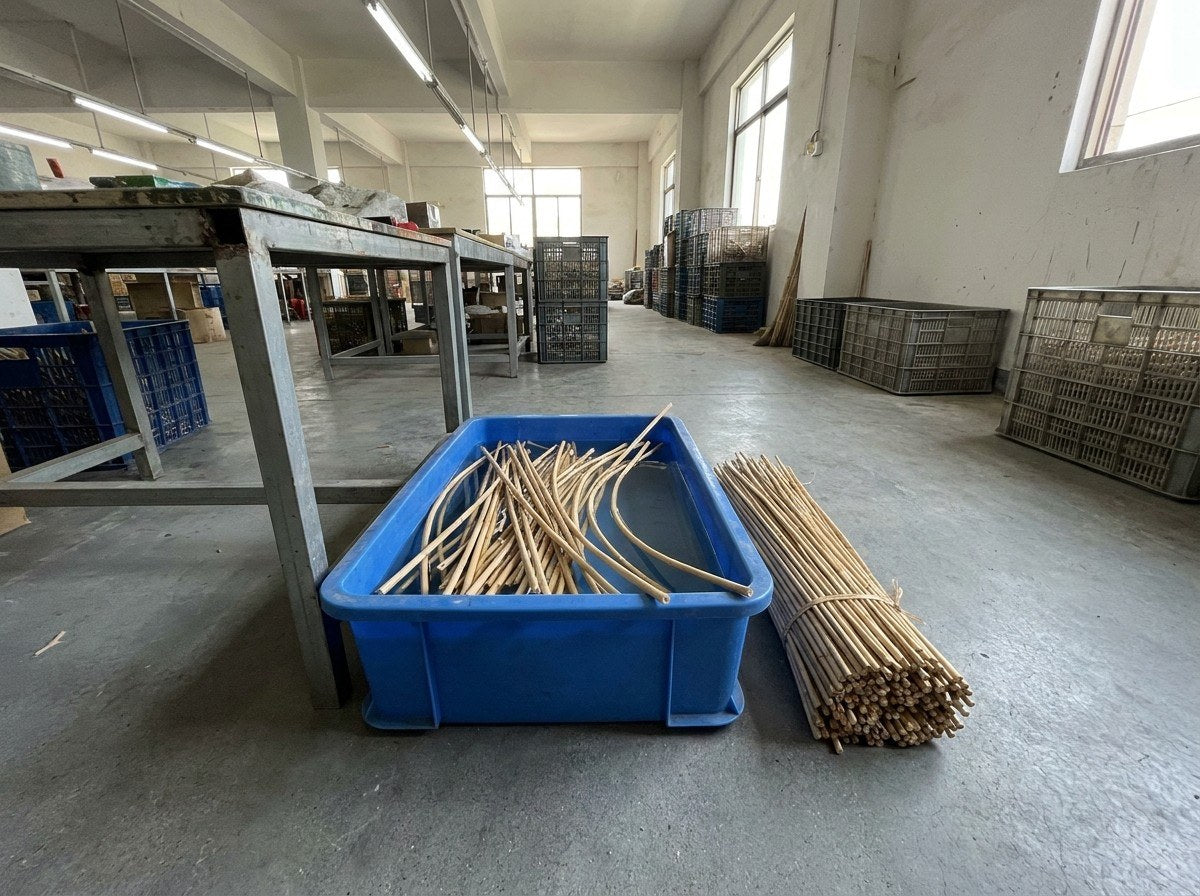
This is where many fine ideas stop. Before going further, we ask the workshop what the material really allows: at that span, will rattan hold? The answer comes down to one simple step, soaking. The strands go into water until they turn supple, they can then be bent without breaking, and they set as they dry. Once feasibility is confirmed, we move on to the drawing.

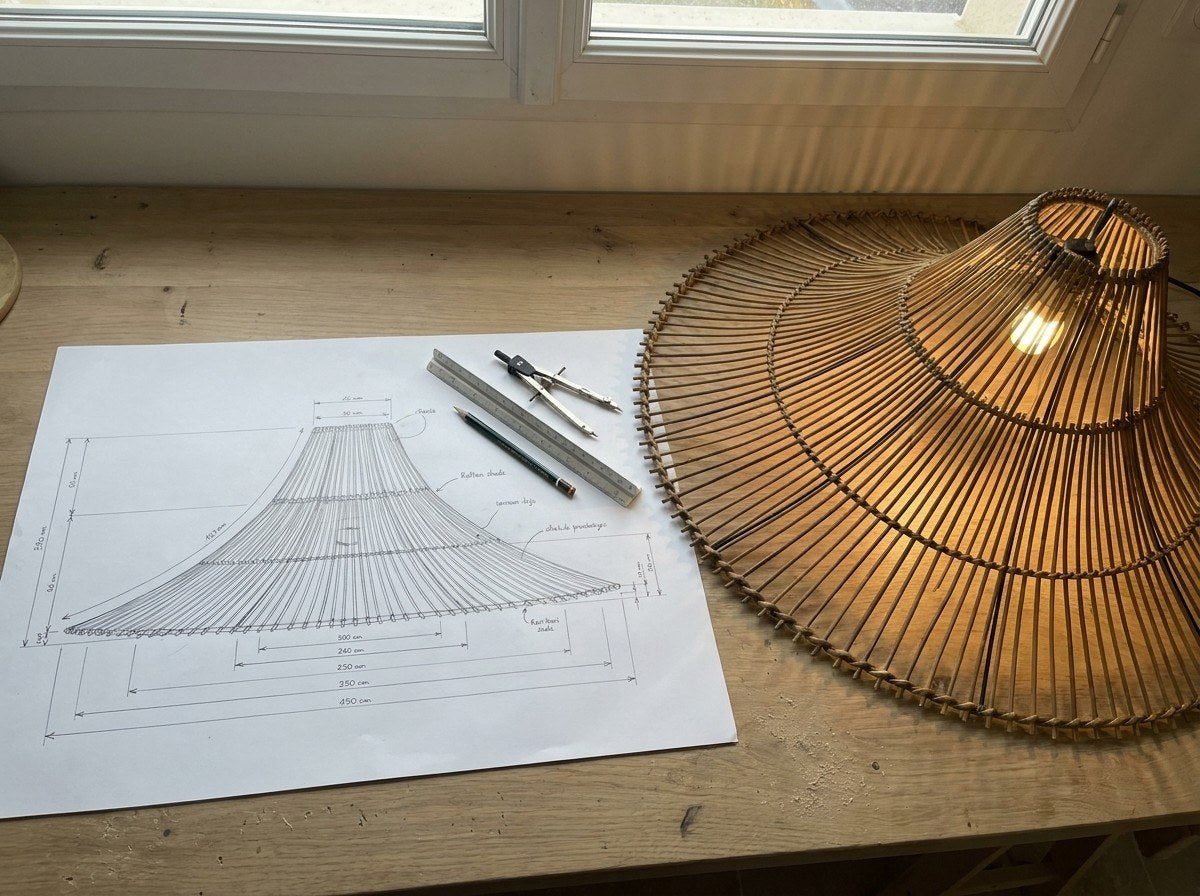
A flared, very open shape, almost a hat, with rods spaced far enough apart for the light to pass between them. The proportions are drawn and redrawn: too flat and the shade dazzles, too deep and it traps the light. A real piece is then assembled and switched on, and we look at the radiating pattern it casts on the ceiling.
Once the design is approved, the workshop starts the production run. The pieces reach the warehouse, where order pickers wrap them one by one before dispatch, ready to dress a new home.