"Palawan Bamboo 1 Shade, White" Pendant Lamp by Good & Mojo
Dispatch. We dispatch your parcels Monday to Friday, within 1 to 2 working days of order confirmation. Delivery then takes 6 to 18 working days depending on the product and your location.
You will receive tracking information within 24 hours of your order leaving the warehouse, at the email address given at checkout.
Returns and exchanges. Both are accepted within the statutory period of 14 days after your order is delivered to your home.

The Palawan Bamboo Shade, White draws its inspiration from the idyllic province of Palawan in the Philippines, famous for its conservation initiatives and its people living in harmony with the environment.
This light embodies the region's commitment to sustainability and community well-being, using environmentally friendly materials.

Carefully made by local artisans in South-East Asia from natural bamboo with a white finish, this pendant lamp features a woven shade that blends tradition and modernity.
The brilliant white of the bamboo adds a touch of freshness and brightness, ideal for complementing Scandinavian, boho or contemporary décor.
The 350 cm transparent cord offers flexible installation, letting you hang the lamp at various heights, making it as practical as it is attractive for lighting both residential and commercial interiors.

By purchasing the "Palawan Bamboo 1 Shade, White", every customer helps plant a tree and distribute a solar lamp to communities in need, supporting Good & Mojo's efforts towards a more sustainable and fairer future.
Bring a touch of purity and elegance to your interior with the Palawan Bamboo Shade, White by Good & Mojo, and light up your space while helping build a more sustainable world.
A beautiful shape is not enough: the material still has to accept it. Before approving a design, we go through it with the workshops that will make it. Here is how one of our pieces came to life.

It all starts with a trend. We follow what circulates on Pinterest, Instagram and interior blogs, and we spot the styles on the rise. Here it was the natural look: plant fibres, wide shapes, warm tones. We also look at where the piece will live, and this one needs height or width: above a large table, in a stairwell, under a cathedral ceiling.

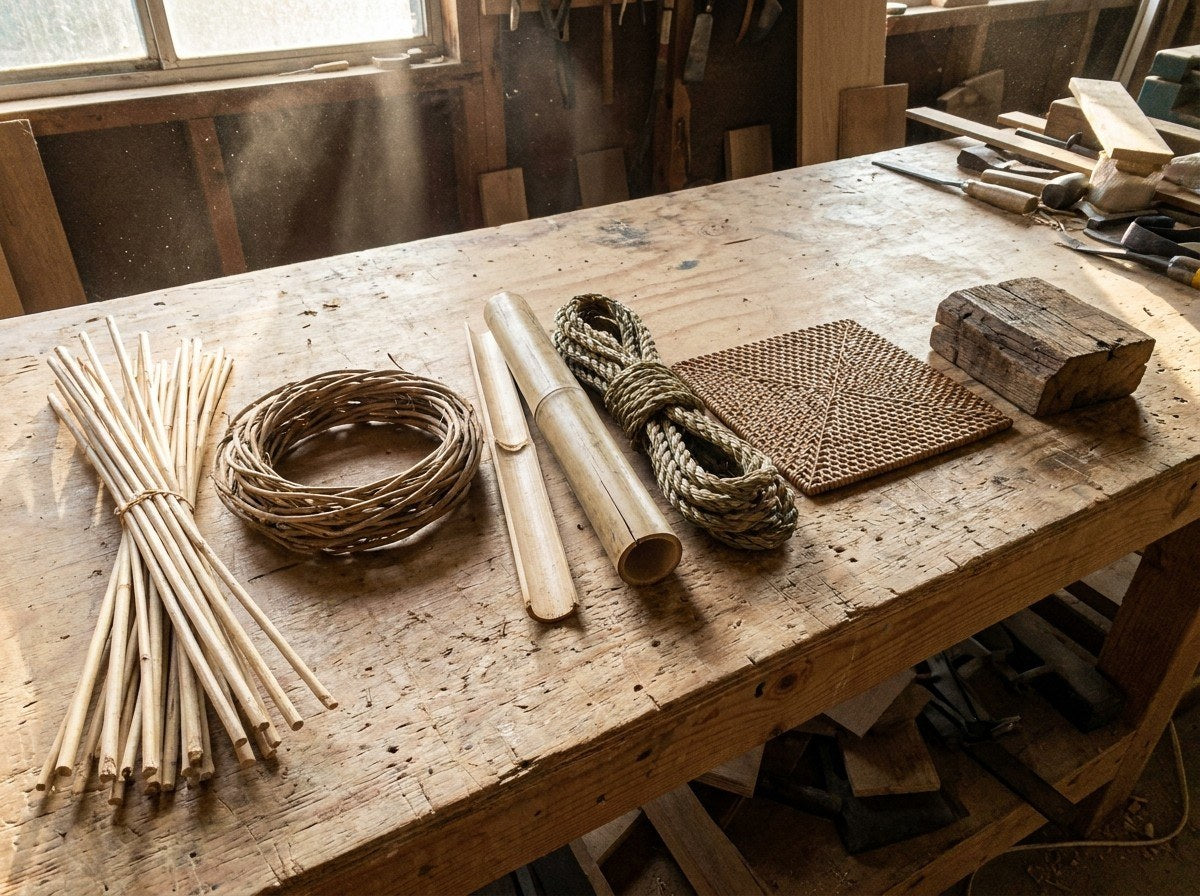
The style appelle la fibre végétale, mais toutes ne se valent pas. L'osier casse au cintrage, le jonc de mer reste raide. Le rotin, lui, est une liane de palmier grimpant d'Asie du Sud-Est : trempée, elle devient souple et accepte n'importe quelle courbe, puis se fige en séchant. Sur une pièce de cette envergure, ce rapport entre souplesse au montage et tenue une fois sec décide de tout.

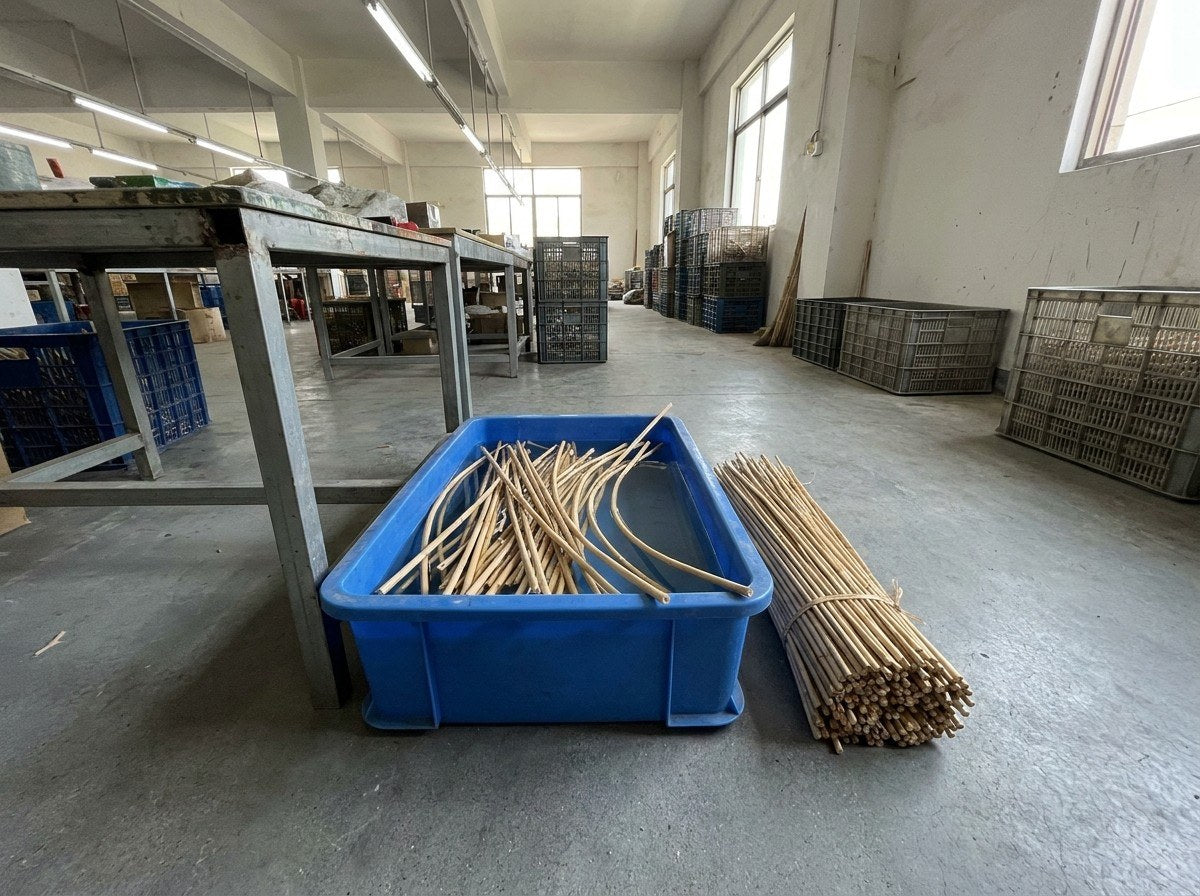
This is where many fine ideas stop. Before going further, we ask the workshop what the material really allows: at that span, will rattan hold? The answer comes down to one simple step, soaking. The strands go into water until they turn supple, they can then be bent without breaking, and they set as they dry. Once feasibility is confirmed, we move on to the drawing.

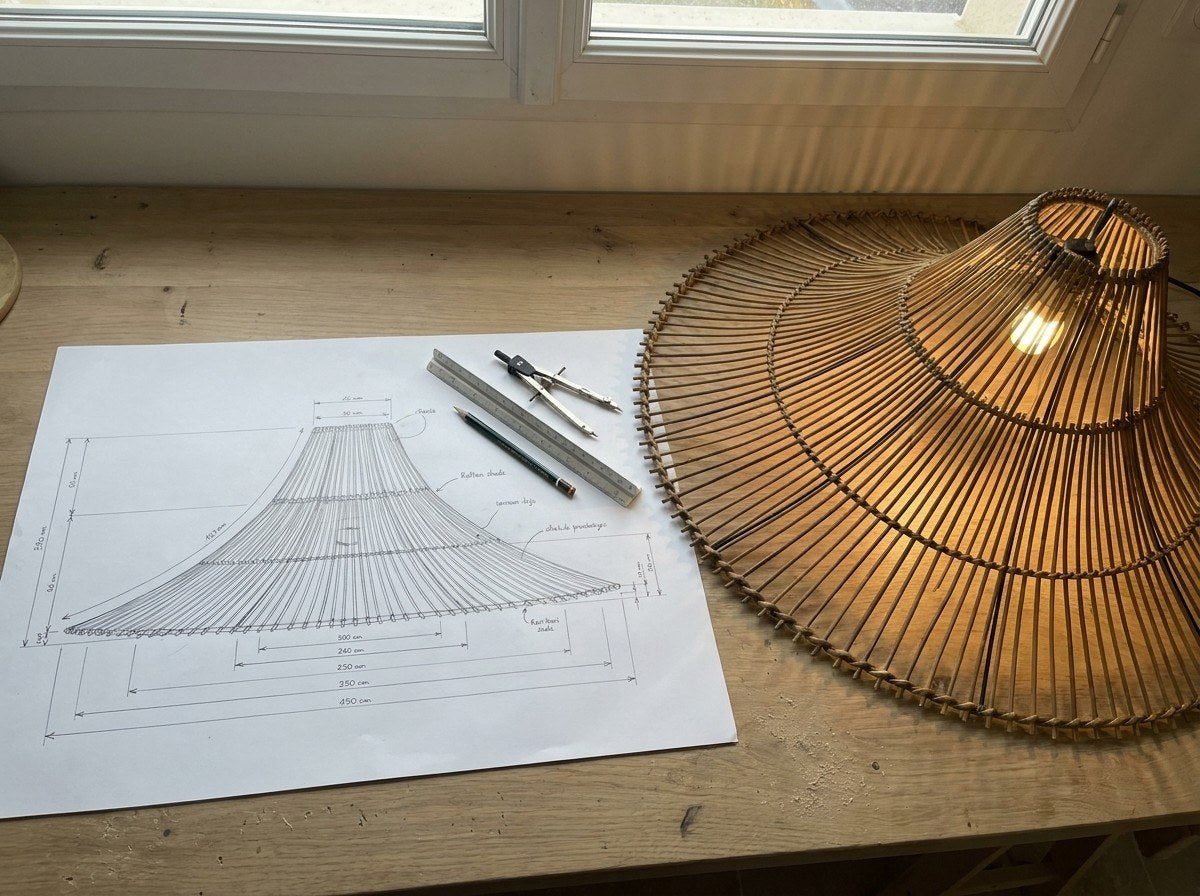
A flared, very open shape, almost a hat, with rods spaced far enough apart for the light to pass between them. The proportions are drawn and redrawn: too flat and the shade dazzles, too deep and it traps the light. A real piece is then assembled and switched on, and we look at the radiating pattern it casts on the ceiling.
Once the design is approved, the workshop starts the production run. The pieces reach the warehouse, where order pickers wrap them one by one before dispatch, ready to dress a new home.